



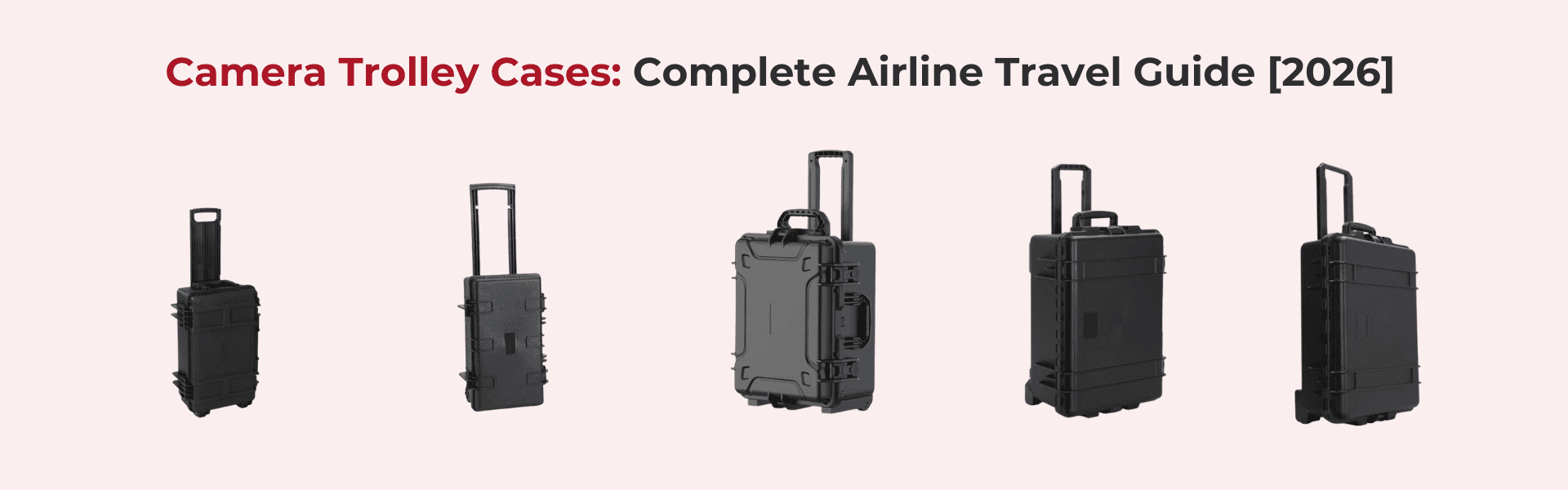
If you fly with camera gear, the difference between arriving on time and arriving with broken equipment usually comes down to one decision: the case you checked it in. A camera trolley case, which is a hard-shell case with integrated wheels and a telescoping handle, is the working photographer’s standard for flights, long transfers, and field travel. This guide covers every camera trolley case in the Case N Foam range, the Indian domestic airline rules that apply in 2026, and practical advice on carry-on versus checked baggage for camera kits.
For the broader framework on case selection, start with our camera protective case guide. If you are choosing a case by camera type rather than by travel use, see the camera hard case buyer’s guide.
Why Trolley Cases Matter for Camera Travel
A photographer’s kit easily clears 15 kg. Body, two or three lenses, a telephoto, tripod, batteries, chargers, laptop, hard drives, filters, cables, cleaning gear: it adds up. Carrying that weight by a side handle through airport terminals, metro stations, and taxi transfers is a recipe for shoulder strain and rushed handovers that damage gear.
A trolley case solves three problems at once.
Weight distribution. Integrated wheels transfer the kit weight from your shoulder to the floor. You walk further, faster, and with less fatigue.
Airline-ready construction. Every Case N Foam trolley case in the EW series is fully waterproof with a gasket seal and pressure equalization valve. That means your gear is sealed against the dust, moisture, and pressure changes of airline cargo holds.
Lockable security. Dual padlock holes on every case accept TSA-approved locks for international travel or standard padlocks for domestic. Your gear is secure through check-in, baggage handling, and hotel storage.
The tradeoff against a non-trolley case is a small addition to external dimensions. Wheels and the telescoping handle add roughly 20 to 30 mm in length. This matters for cabin carry-on (see below) but rarely for checked baggage.
Indian Airline Cabin Baggage Limits (2026)
Cabin carry-on rules for Indian domestic carriers are similar across airlines but not identical. These are the current 2026 dimensions and weight limits for the four major domestic airlines. Always verify with your specific airline before travel, as fare classes (corporate, flexi, saver) can change allowances.
| Airline | Cabin Dimensions (L × W × H) | Cabin Weight | Personal Item | Source |
|---|---|---|---|---|
| IndiGo | 55 × 35 × 25 cm | 7 kg total (cabin + personal) | 45 × 35 × 20 cm | goindigo.in |
| Air India (Economy Domestic) | 55 × 40 × 20 cm (sum ≤ 115 cm) | 8 kg | 40 × 30 × 20 cm, 3 kg | airindia.com |
| SpiceJet (Boeing) | 55 × 35 × 25 cm (sum ≤ 115 cm) | 7 kg | Within 7 kg limit | spicejet.com |
| SpiceJet (Q400 turboprop) | 50 × 35 × 23 cm (sum ≤ 108 cm) | 7 kg | Within 7 kg limit | spicejet.com |
| Akasa Air | Sum ≤ 115 cm (typically 55 × 35 × 25 cm) | 7 kg | 3 kg, under-seat fit | akasaair.com |
Note: Vistara completed its merger with Air India in November 2024. All former Vistara flights now operate under Air India codes (AI 2XXX) with Air India baggage rules.
For international flights, cabin limits are airline-specific but most follow the IATA recommendation of 56 × 45 × 25 cm (about 115 cm sum) with weight limits ranging from 7 kg (many Asian carriers) to 10 kg (some European and Middle East carriers). Always check your specific airline before travel.
Checked Baggage Rules for Camera Trolley Cases
Checked baggage limits vary by airline, fare, and route. These are the baseline allowances for 2026 domestic economy tickets on major Indian carriers.
| Airline | Domestic Economy Checked Allowance |
|---|---|
| IndiGo | 15 kg (1 piece) |
| Air India | 15 kg (domestic economy baseline; higher on premium fares) |
| SpiceJet | 15 kg (1 piece domestic) |
| Akasa Air | 15 kg (free tier) |
International checked allowances are typically 20-30 kg per piece on economy international, with some airlines to the Middle East allowing 30 kg. Maximum single-bag weight for handling safety is usually 32 kg regardless of ticketed allowance.
Practical rule for photographers: if your total kit weight exceeds the checked allowance, you have two options. Pay excess baggage (INR 600 per kg plus GST on Air India domestic, similar on others), or split your kit across carry-on and checked cases. For a full kit that includes a laptop, carrying valuable glass as carry-on and checking the rest saves money and reduces risk.
What Fits in Each Camera Trolley Case
Case N Foam offers nine trolley-equipped or suitcase-format models sized from compact to broadcast-grade. Pick based on the camera configuration you travel with.
Small Trolleys (500-530 mm): Carry-On Candidates
These are the trolleys sized to potentially fit as cabin carry-on on Indian domestic flights, depending on external dimensions and weight. Always verify against your specific airline’s limits.
EW5219-TR Video Camera Case (522×275×185 mm internal). Sized for one full-size camera body with a 24-105 mm lens attached, plus two additional lenses and a small accessory kit. Internal length of 522 mm places external length around 550-560 mm; verify against IndiGo’s 55 cm limit before relying on it as carry-on.
EW5220-TR Video Equipment Case (515×288×200 mm internal). Slightly wider than the EW5219-TR, accommodates a rigged mirrorless cinema body (Blackmagic Pocket 6K with cage) or a DSLR with a 70-200 mm zoom attached plus batteries. Deeper profile means more cargo capacity at the cost of weight.
EW5320-TR Camera Flight Case (530×310×200 mm internal). The photographer’s workhorse trolley. Holds a full DSLR or mirrorless kit (body, three lenses, flash, batteries, chargers, filters, cleaning kit, and a small drone if packed efficiently). External dimensions exceed most domestic carry-on limits; this is a checked case for airline travel.
Medium Trolleys (580-600 mm): Checked Baggage
These sizes are designed for checked baggage use and hold substantial kit volumes.
EW5827-TR Trolley Equipment Case (580×390×270 mm internal). A full kit case. Holds a DSLR or mirrorless body with lens attached, 3-4 additional lenses, flash, audio recorders, hard drives, laptop sleeve, and accessories. This is the “one case for everything” option for solo travelling photographers.
EW6020-TR Tripod Case (600×455×200 mm internal). Designed primarily for tripods and long accessories (light stands, boom poles, monopods) but also works as a flat-profile trolley for slim kit layouts. The 455 mm width allows two or three lenses side-by-side.
Drone Trolleys
Drone pilots travelling with full setups need dedicated trolley cases. The combination of drone body, controller, spare batteries, props, and filters has a specific shape that the general camera trolley does not accommodate efficiently.
EW5022-TR Drone Case (500×400×218 mm internal). Fully waterproof trolley for DJI Mavic, DJI Mini, FPV drones, and mid-size consumer to prosumer quads. Holds drone body, controller, spare batteries, props, charger, SD cards, and tools.
Non-Trolley Cases for Camera Travel
Two models offer travel-grade volume without integrated wheels. These work when you have porter support, a cart, or a vehicle-based travel model.
EW5221 Video Production Case (521×325×208 mm internal). Similar capacity to the EW5220-TR but without trolley wheels. Lighter overall, suited to ground-based video production where wheels are not needed.
EW5421 Hard Case for Camera Equipment (538×380×210 mm internal). Deep-profile non-trolley case for cinema rigs and broadcast kits. Pair with a separate tripod trolley for full production transport.
Practical Airline Packing for Camera Kits
Flying with camera gear rewards planning. These are the rules we have learned from photographers who fly regularly.
Batteries fly in carry-on, always. Lithium batteries above 100 Wh are prohibited in checked baggage per DGCA and IATA rules. Smaller batteries (under 100 Wh) are allowed in checked bags but cabin carry is safer. If your checked bag is delayed, you still have power to shoot.
Valuable glass travels in cabin when possible. A fast telephoto prime costs more than an intercontinental flight. If it will fit in your cabin allowance, it belongs there.
Use TSA locks for international flights. International security may need to inspect your case. A TSA-approved lock lets them open and relock without damage. Standard padlocks get cut.
Declare fragile equipment at check-in. Indian airlines do not have a formal “fragile” sticker process for cameras, but informing the check-in agent that your bag contains camera equipment often results in more careful handling. No guarantees, but it costs nothing to mention.
Photograph your kit before you fly. A phone photo of your full kit laid out, with serial numbers where visible, makes insurance claims significantly easier if anything gets lost or damaged.
Know your insurance limits. Most commercial airlines cap their liability for checked baggage at approximately $2,000 (around ₹1.65 lakh) regardless of gear value. Standalone camera insurance is essential for professional kits exceeding this value.
What to Look For in a Camera Trolley Case
Not every trolley case is airline-grade. These are the specifications that separate a serious camera trolley from a consumer rolling case.
Wheel quality. Look for wheels that are replaceable (bolt-mounted, not riveted) and rated for the full loaded weight of the case. Cheap trolley cases use riveted wheels that cannot be replaced when they fail, and they always fail on the wrong trip.
Handle build. The telescoping handle is the most stressed component on any trolley case. Look for aluminium frames, dual rails (not single), and push-button locks that positively engage in both extended and retracted positions.
Gasket seal and pressure valve. For any flight at altitude, a pressure equalization valve is non-negotiable. Without it, sealed cases can be difficult to open after a flight because of internal-external pressure differences. Every EW series Case N Foam trolley includes one.
Padlock holes. Two reinforced padlock holes minimum, sized for standard or TSA locks. The padlock holes must be integrated into the case body, not riveted accessories that can be pried off.
Foam interior compatibility. Pre-cut foam is fine for generic gear. Custom foam is essential for irregular shapes, valuable glass, and production kits where gear needs to stay exactly where you put it. Every Case N Foam trolley is available with empty, plain PU, or custom CNC-cut XLPE foam. See our custom foam guide for the decision framework.
Top Camera Trolley Picks for 2026
| Use Case | Model | Internal Dimensions | Trolley |
|---|---|---|---|
| Compact mirrorless kit, attempt carry-on | EW5219-TR | 522×275×185 mm | Yes |
| Standard DSLR kit, checked | EW5320-TR | 530×310×200 mm | Yes |
| Full travel kit | EW5827-TR | 580×390×270 mm | Yes |
| Tripods and long accessories | EW6020-TR | 600×455×200 mm | Yes |
| Drone pilot travel | EW5022-TR | 500×400×218 mm | Yes |
Frequently Asked Questions
Can I carry a camera trolley case as cabin baggage on IndiGo?
Only if external dimensions are within IndiGo’s 55×35×25 cm limit and total weight is under 7 kg. Our smallest trolleys like the EW5219-TR have internal dimensions close to the limit; external dimensions are slightly larger. In practice, most camera trolley cases with a full kit exceed the 7 kg cabin weight limit even if they fit the size envelope. Plan to check your trolley on domestic Indian flights.
What is the best camera trolley case for international travel?
The EW5320-TR or EW5827-TR are the most versatile international travel picks. Both are fully waterproof with TSA lock-compatible padlock holes. For documented IP67 certification (required by some insurance policies and institutional buyers), step up to the MAX series, though MAX-format cases are not sold with trolley wheels in all sizes.
How much camera gear fits in a trolley case?
A full DSLR kit (body, three lenses, flash, batteries, chargers, filters, cleaning gear, laptop, hard drives) typically needs 530×310×200 mm of internal volume. That maps to the EW5320-TR or larger. Mirrorless kits fit in 500×275×185 mm (EW5219-TR territory). Drone kits with controllers fit the EW5022-TR.
Are Case N Foam trolley cases airline-approved?
“Airline-approved” is not a formal designation for checked baggage; any hard case within weight limits works. For carry-on, the case must fit your specific airline’s cabin dimensions and weight limit. All EW-series trolley cases are built to handle the rigors of checked airline baggage: waterproof, pressure-equalized, lockable.
Can I check my camera trolley case with fragile stickers?
Indian airlines do not use formal fragile sticker programs. You can verbally request careful handling at check-in. The more important factor is the case itself. A sealed EW-series trolley with custom foam protects gear regardless of how the airline handles it.
Do trolley case wheels hold up to airline baggage handling?
Quality trolleys hold up for years of regular use. Case N Foam trolley wheels are bolt-mounted and replaceable, so even if a wheel fails after heavy use, a local repair replaces it rather than requiring a new case. Cheap riveted-wheel trolleys fail irreparably.
What size camera trolley fits airline cabin across all Indian domestic carriers?
The strictest limit is SpiceJet’s Q400 turboprop at 50×35×23 cm, 7 kg. If you need absolute domestic carry-on compatibility across every aircraft type, no trolley case in our camera range meets that envelope. Plan to check your trolley on turboprop routes and use a soft daypack for carry-on valuables.
Should I buy a camera trolley with or without custom foam?
With custom foam if your kit is stable (you shoot with the same gear repeatedly), and with plain PU or empty foam if your kit changes frequently. Custom foam adds 3-7 days to delivery but adds years of reliable protection.
Travelling Smart with Your Camera Kit
A camera trolley case is an investment that pays back the first time you walk an airport terminal with 15 kg of gear and arrive rested. The right trolley for your kit depends on what you shoot and how often you fly. Compact mirrorless shooters do well with the EW5219-TR. DSLR photographers step up to the EW5320-TR. Full-kit travelling professionals move to the EW5827-TR. Drone pilots have the dedicated EW5022-TR.
Whatever size you pick, the airline rules stay the same: cabin limits are tight on Indian domestic carriers, checked baggage allowances are generous enough for full kits, batteries travel in carry-on, and TSA locks are standard for international travel.
For the broader protective case framework, return to the camera protective case buyer’s guide. For case selection by camera type, see the camera hard case buyer’s guide.
Shop the full Case N Foam trolley range and order online. Custom foam consultation available on request. Ships free across India.