



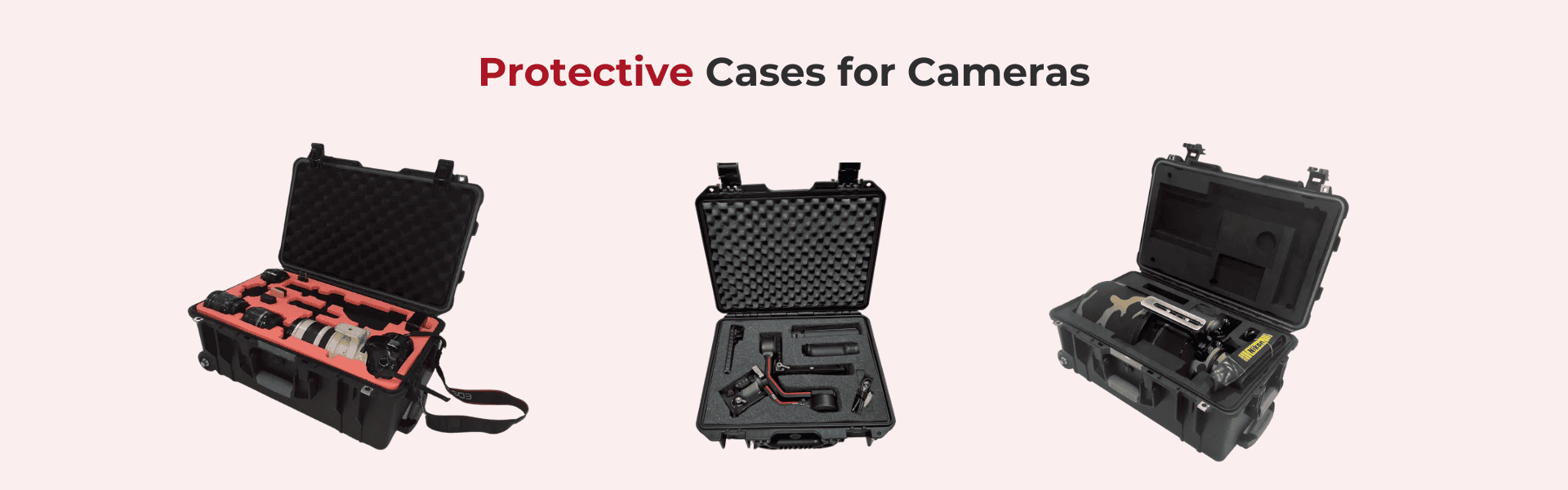
A camera protective case is the difference between a ruined shoot and a completed one. Soft bags handle everyday carrying fine, but the moment you add rain, checked baggage, field travel, or a three-foot fall from a tripod, only a hard protective case stands between your gear and an expensive replacement bill. This guide covers every kind of camera protective case in India, from compact mirrorless shells to full production trolley cases, with real internal dimensions, protection ratings, and model recommendations drawn from the Case N Foam catalogue of 41 camera-ready SKUs.
If you have read our earlier take on why protective cases for cameras matter, consider this the expanded 2026 reference: dimension tables, protection tiers, buying advice, and side-by-side picks. Two companion guides go deeper on specific use cases: the camera hard case buyer’s guide for DSLR, mirrorless and GoPro setups, and the camera trolley cases airline travel guide for working photographers on the move.
What a Camera Protective Case Actually Protects Against
Every camera kit faces five predictable threats during transport and storage, and a protective hard case is engineered to handle each of them.
Impact and shock. Drops from a table, airport conveyor belts, and baggage-handler throws all transmit force into lens elements, sensor mounts, and glass filters. A rigid polypropylene shell with custom foam absorbs and distributes that force so your gear does not.
Water and humidity. Monsoon shoots, boat coverage, coastal travel, and the humidity swings of Indian summers all put moisture onto sensitive electronics. A waterproof protective case with a gasket seal and pressure equalization valve keeps water out and regulates internal pressure when you change altitude or temperature.
Dust and fine particulate. Desert shoots, construction site coverage, and industrial venues fill soft bags with dust that migrates into lens barrels, zoom rings and sensor cavities. Sealed hard cases keep the interior clean.
Theft and tampering. Locked padlock holes on hard cases deter opportunistic theft in hotels, airport lounges, and during vehicle transfers. Soft bags with zipper pulls offer no real security.
Disorganization and abrasion. Lenses shifting against camera bodies, batteries knocking into filters, and cables tangling with accessories cause wear over time. Custom foam holds each item in a defined cavity so nothing moves and nothing touches anything it should not.
Soft Camera Bag vs Protective Hard Case
Both have a place. The question is matching the bag to the job.
| Factor | Soft Camera Bag | Camera Protective Case |
|---|---|---|
| Weight | Light (0.5 to 2 kg) | Heavier (1.5 to 8 kg) |
| Weather sealing | Rain cover only | Full gasket seal on EW/MAX series |
| Impact protection | Basic foam padding | Rigid shell + custom foam |
| Security | Zipper only | Padlock holes, TSA-compatible |
| Checked baggage | Not recommended | Designed for it |
| Field conditions | Fair weather only | Rain, dust, salt spray, altitude |
| Price point | ₹2,000 to ₹15,000 | ₹2,500 to ₹25,000 |
A soft bag is the right choice for short city assignments, studio-to-location drives, and assignments where weight matters more than ruggedness. A camera protective case is the right choice the moment you fly with gear, shoot in unpredictable weather, or carry equipment that would cost more than a used car to replace.
The Three Protection Tiers Explained
Every Case N Foam camera protective case falls into one of three protection tiers. Picking the right tier saves you money and matches the case to how you actually shoot.
Water-Resistant (ET Series)
The ET series is dustproof, crushproof, and water-resistant. It handles rain splashes, light showers, and humid environments but is not rated for submersion. ET cases are a strong middle-ground choice for studio photographers who occasionally shoot outdoors, hobbyists who fly a few times a year, and students protecting a first serious kit.
Representative ET models for camera gear: mirrorless camera case (ET2610, 256×182×96 mm), DSLR camera case (ET3113, 307×205×125 mm), camera bag hard case (ET3313, 326×246×126 mm), and photography hard case (ET3514, 350×265×135 mm).
Fully Waterproof (EW Series)
The EW series is fully waterproof, dustproof, and crushproof with a pressure equalization valve that balances internal air pressure when altitude or temperature changes. This is the tier most working photographers and videographers should be buying. It handles checked baggage, monsoon conditions, boat shoots, desert assignments, and hill-station altitude changes without letting moisture or dust inside.
Popular EW models for cameras include the camera case (EW3418, 343×220×175 mm) for a standard DSLR plus two to three lenses, the DSLR waterproof case (EW2912, 294×215×130 mm) for a single body with one lens, the camera hard case (EW4414, 440×320×140 mm) for larger kits, and the camera suitcase (EW3921, 388×268×206 mm) for deep-profile setups with zoom lenses attached.
Military-Grade IP67 (MAX Series)
The MAX series is waterproof, dustproof, crushproof, IP67 rated, and military-grade, manufactured in Italy by Panaro with more than 60 years of injection moulding expertise. MAX cases are the right choice when you need documented certification for institutional procurement, broadcast insurance requirements, or extreme-environment work.
The standout MAX model for photographers is the photography equipment case (MAX465h125, 465×335×125 mm), sized for a full mirrorless kit with three lenses and accessories. For broadcast and cinema rigs, the broadcast camera case (MAX750h280, 750×480×280 mm) holds large camera bodies with matte boxes, follow focus units, and battery plates.
A note on specification language: only MAX-series cases carry the IP67 rating. EW-series cases are fully waterproof in practical terms but are not sold with an IP67 certification, so when you need formal paperwork for tenders or insurance, reach for MAX.
Choosing the Right Size
Case size is determined by your largest assembled piece of gear, usually a camera body with a lens attached, or a long telephoto lens. Always work in internal dimensions. The external size of a case is always larger than the internal by the thickness of the shell and foam, so reading internal-only dimensions prevents the classic “it looked big enough online” mistake.
For Mirrorless and Compact Kits
Mirrorless bodies with a pancake or kit lens rarely exceed 200 mm in total length. The mirrorless camera case (ET2610, 256×182×96 mm) fits a Sony A7 series, Fujifilm X-T, or Canon R body with one to two compact primes. For a mirrorless kit with flash and a second lens, step up to the ET2810 (280×200×100 mm) or the camera foam case (ET2812, 280×200×120 mm).
For DSLR and Hybrid Kits
A DSLR body with a 24-70 mm zoom attached runs 200 to 220 mm. The DSLR camera case (ET3113, 307×205×125 mm) fits this combination with room for a second lens. For a full DSLR kit (body, 2 lenses, flash, batteries, chargers), the camera bag DSLR (ET3315, 326×246×150 mm) or EW3418 (343×220×175 mm) are the go-to sizes.
For Cinema and Large-Sensor Video
Cinema bodies like the Sony FX, RED Komodo, and Blackmagic Pocket 6K add rods, cages, matte boxes, and follow focus units that push overall dimensions past 400 mm. The camera protection case (ET4114, 405×298×143 mm) works for a rigged mirrorless cinema setup. For full cinema builds, the hard case for camera equipment (EW5421, 538×380×210 mm) and MAX750h280 give the depth and footprint needed.
For Drone and Action Camera Kits
Drones and action cameras get their own category because the gear shapes are so different. The GoPro waterproof case (ET1909, 194×128×86 mm) and action camera waterproof case (ET2209, 215×144×86 mm) are sized for a single action body with batteries and mounts. For DJI drones, the Mavic Air 2 hard case (EW4120, 409×278×198 mm) and DJI drone bag (EW4319, 436×318×190 mm) give a proper form-fit home for folded drones, controllers, batteries, and spare props.
Top 5 Camera Protective Cases from Case N Foam
These are the five models that cover the majority of photographer and videographer use cases.
1. EW3418 Camera Case (343×220×175 mm). The everyday workhorse. Fits a DSLR or mirrorless body with two lenses and accessories. Fully waterproof, a sensible size for both carry-on flights and everyday transport.
2. EW2912 DSLR Waterproof Case (294×215×130 mm). Tightly sized for a single DSLR plus one lens. Ideal as a second case for a grab-and-go body or as a dry storage box at home.
3. ET2610 Mirrorless Camera Case (256×182×96 mm). The compact pick. Water-resistant ET construction, slim profile, fits a mirrorless body with two compact primes. Best for photographers who fly often and need a case small enough to stash anywhere.
4. MAX465h125 Photography Equipment Case (465×335×125 mm). The professional choice. IP67 rated, full mirrorless kit capacity, the case to pick when you need documented protection for insurance or institutional procurement.
5. EW5320-TR Camera Flight Case (530×310×200 mm). The travel workhorse. Waterproof EW build with integrated trolley wheels and telescoping handle. Holds a full kit plus accessories. For a deep dive on trolley options, see our camera trolley cases airline travel guide.
Custom Foam: The Inside That Matters
A tough exterior protects against the outside world, but the foam inside is what protects gear from itself. Every Case N Foam camera protective case is available in three foam configurations.
Empty case. No foam inside. Suitable if you plan to order a custom insert later or already have foam from a previous case.
Plain PU foam. A standard polyurethane foam lining that provides basic cushioning and can be shaped by hand to fit loose equipment. Good for generalists who carry different gear on different days.
Custom-cut XLPE foam. High-density closed-cell foam CNC-cut to your exact camera body, lens profiles, battery shapes, filter sizes, and accessory outlines. This is the configuration professional photographers and institutional buyers should order. Our guide on why custom foam inserts are a game-changer covers the decision in depth.
Custom foam matters most when gear is expensive, shapes are irregular, or the case will be checked as airline baggage. A precisely cut foam insert stops gear from shifting regardless of how roughly the case is handled.
Travel, Airlines, and Camera Protective Cases
Working photographers fly. The size of your protective case matters for two airline limits: cabin (carry-on) size and checked baggage size and weight.
For cabin use on Indian domestic carriers, the common limit is 55 × 35 × 25 cm with a 7 kg weight ceiling (8 kg on Air India economy). Our smaller camera trolley cases, the video camera case (EW5219-TR) and video equipment case (EW5220-TR), have external dimensions that fit within these limits when packed reasonably. For the full airline breakdown, read the camera trolley cases airline travel guide.
For checked baggage, any Case N Foam camera protective case works, but the EW and MAX series are the right choice because they are fully waterproof and sealed against the dust and moisture that luggage holds accumulate. Lock both padlock points with TSA-approved locks for international flights.
Lithium batteries above 100 Wh must always travel in carry-on, never checked. That rule is set by the DGCA and IATA, and it applies regardless of how protective your case is.
Frequently Asked Questions
What is the difference between a camera case and a camera protective case?
A “camera case” is a broad term that includes soft bags. A “camera protective case” specifically refers to hard-shell cases built for impact, water, and dust protection. Every case in this guide is a protective hard case.
Are camera protective cases worth the weight?
For working photographers, yes. The additional 1 to 3 kg over a soft bag is trivial compared to the replacement cost of a single mid-range lens. For occasional hobbyists who never fly or shoot outdoors, a soft bag with a rain cover may be sufficient.
Can I put my camera protective case in checked baggage?
Yes, and that is what most hard cases are built for. The EW and MAX series are fully waterproof and handle the rough handling of airline luggage without transmitting damage to gear. Use TSA-approved locks on the padlock points for international flights.
Do I need IP67 certification for my camera protective case?
Only if your insurance, institution, or tender requires it in writing. The EW series is fully waterproof for all practical purposes but is not sold with a formal IP67 certificate. If you need documented certification, the MAX series provides it.
What size camera protective case should I buy?
Measure your largest assembled camera configuration (body plus longest lens attached) and add 20 to 30 mm of clearance on each side for foam. Then match to the internal dimensions in the size guide above. When in doubt, size up rather than down.
Can a camera protective case double as a general equipment case?
Absolutely. A 343×220×175 mm camera case works equally well for drones, portable audio recorders, medical equipment, or survey instruments. Custom foam can be reordered or re-cut as your gear changes.
Are Case N Foam camera protective cases available in India?
Yes. All models are stocked and ship free across India. Domestic delivery is typically 3 to 7 working days. Custom foam orders add 7 to 15 days to the timeline.
Picking Your Camera Protective Case
Your camera gear is expensive, irreplaceable on a shoot day, and depreciating the moment you walk out the door with a soft bag. A camera protective case is not a luxury item. It is the insurance policy that activates every time you leave a controlled environment. Whether that is a domestic flight, a monsoon shoot, a drone assignment in a desert, or simply putting gear in the back of a taxi, the right hard case in the right size with the right foam stops problems before they become claims.
Start with the three-tier framework: ET for indoor-to-vehicle work, EW for anything outdoors or on an aircraft, MAX when you need documented protection. Match size to your largest assembled kit. Add custom foam when gear is valuable enough to earn a proper home. For specific camera-type breakdowns, move on to the camera hard case buyer’s guide. For flying with gear, the camera trolley cases airline travel guide covers cabin limits, checked baggage, and airline-specific rules.
Shop the full range of Case N Foam camera protective cases on our online store, or reach out with your gear list for a custom foam recommendation. Ships free across India.