



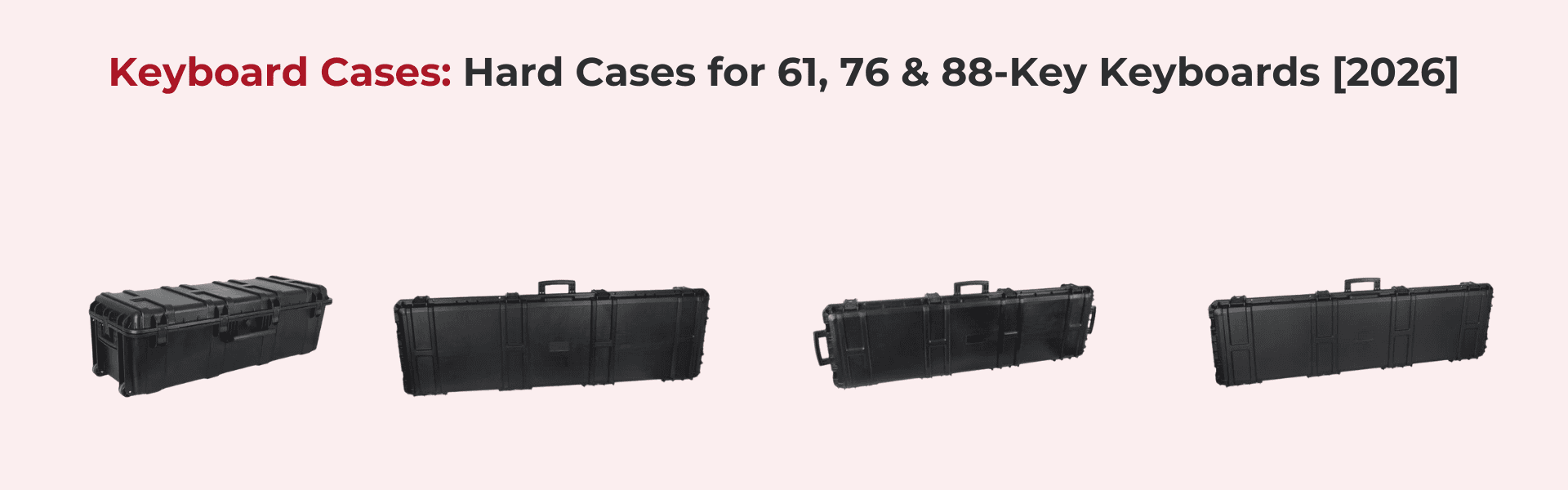
A keyboard case has one job: get your instrument to the gig with every key working. This guide is about hard cases for musical keyboards, from 25-key MIDI controllers to 88-key digital pianos. (If you searched for a computer keyboard sleeve, this is not that page.)
Keyboards fail in transit more than almost any instrument. The keybed is a row of dozens of moving parts sitting in a thin plastic housing, and the standard way Indian musicians move them, wrapped in a bedsheet on the back seat, or in a padded gig bag under three other bags in a tempo traveller, is exactly how keys go silent and pitch wheels snap. A foam-fitted hard case ends that permanently.
Below you will find a sizing method, a case ladder from MIDI controllers up to 88-key stage pianos, and real internal dimensions for every case so you can check your own instrument before buying.
Gig Bag vs Keyboard Case: What Padding Actually Does
A padded gig bag protects against scratches. It does almost nothing against the three things that actually kill keyboards:
- Crushing. Bags stack. A 15 kg speaker on top of your gig bag presses directly onto the keybed.
- Corner impact. Keyboards are long, so they get carried through doorways and loaded diagonally. Corner knocks travel straight into the chassis and the ribbon cables behind the keys.
- Water. Monsoon load-ins are a fact of gigging life in India. Fabric soaks through in a minute.
A hard keyboard case solves all three: a crushproof polypropylene shell, foam holding the instrument off every wall, and on our EWL series, a waterproof seal with a pressure equalization valve. These are the same case platforms professionals use for guitars and broadcast gear, in lengths that match keyboards.
How to Measure Your Keyboard for a Case
Three numbers decide everything: length, depth (front to back), and height of your keyboard.
- Measure your keyboard in millimetres, including knobs and wheels.
- Add 25 mm on each side for foam. That means the case’s internal length and width should each be at least 50 mm larger than your instrument.
- Check height last: your keyboard’s height should sit at least 20 to 30 mm below the case’s internal height so the lid foam can press down gently.
Manufacturer websites list exact dimensions for every model. Two minutes of measuring beats an unusable case.
The Keyboard Case Ladder: 25 Keys to 88 Keys
Every case below is waterproof (EW/EWL series), crushproof, dustproof, and sold in two variants: Empty Case or Case With Foam (plain PU foam). All lengths are internal dimensions in mm.
| Case | Internal (mm) | Max keyboard footprint* | Typical instruments |
|---|---|---|---|
| EW6020-TR | 600×455×200 | 550×405 | 25/32-key MIDI controllers (MPK Mini, Launchkey Mini) |
| EWL8018-TR | 802×412×182 | 752×362 | 37-key controllers, pedalboards, compact synths |
| EWL9616-TR | 960×500×158 | 910×450 | 49-key and slim 61-key controllers |
| EWL10632-TR | 1061×348×318 | 1011×298 | Slim 61-key (Casio CT-S line), deep space for stands and cables |
| EWL12815-TR | 1287×370×148 | 1237×320 | 76-key slim keyboards, 61-key arrangers (Yamaha PSR-E383) |
| EWL13316-TR | 1336×380×156 | 1286×330 | Slim 88-key digital pianos (Roland FP-10 class) |
| EWL14515-TR | 1457×430×148 | 1407×380 | 88-key stage pianos, deep-bodied 61-key arrangers |
*Max footprint = internal length and width minus 25 mm of foam per side. Always verify height separately.
All cases from the EWL8018-TR upward roll on wheels with a telescopic trolley handle, because nobody should carry 1.3 metres of digital piano by a side handle through a parking lot.
Cases for 61-Key Keyboards
The 61-key segment splits into two body types, and the split matters more than the key count.
Slim portables like the Casio CT-S300 (930×256×73 mm) fit the EWL10632-TR Guitar Flight Case with proper foam margins on every side. Its 318 mm internal depth also swallows your X-stand, sustain pedal, and cable bag under a foam divider, which turns one case into your entire load-in.
Arranger keyboards like the current Yamaha PSR-E383 (941×317×105 mm) are deeper front-to-back than slim portables. The EWL12815-TR (370 mm internal width) takes the PSR-E383 with proper foam on every side, and its extra length becomes accessory storage. Older or bulkier arrangers deeper than 320 mm need the EWL14515-TR, whose 430 mm internal width is the largest in the range.
If your 61-key is a flat MIDI controller under 910 mm, the shorter EWL9616-TR saves money and boot space.
Cases for 76 and 88-Key Keyboards
This is where hard cases stop being optional. A 76 or 88-key instrument is too long for safe solo carrying in a soft bag, and replacement keybeds for stage pianos frequently cost a third of the instrument.
For 76-key slim keyboards up to 1237 mm long and 320 mm deep, the new EWL12815-TR (1287×370×148 internal, 8.3 kg) is the purpose-built answer.
For slim 88-key digital pianos, the EWL13316-TR is a near-perfect envelope. A Roland FP-10 (1284×258×140 mm) sits inside with 26 mm of foam on each end, foam along both long walls, and clearance under the lid.
For 88-key stage pianos and anything wider, the flagship EWL14515-TR (1457×430×148 internal) takes a Yamaha P-145 class instrument (1326×272×129 mm) with generous margins in every direction. Reinforced corners, wheels, and a telescopic handle make it a one-person load-in even at 88 keys.
Deep 76-key arrangers over 380 mm front-to-back are the one category without an off-the-shelf match. Send us your model on WhatsApp and we will confirm the closest case and cut custom foam to bridge the difference where possible.
Synthesizers, MIDI Controllers and Modular Gear
Compact electronic instruments deserve the same treatment, at smaller sizes. A 25-key controller and audio interface kit fits the EW6020-TR (600×455×200 mm) with cavities for cables and a laptop stand. A 37-key synth or a pedalboard-and-controller rig suits the EWL8018-TR. With custom-cut foam, one insert holds controller, interface, and cable coils in separate cavities; if the rig changes later, we cut a fresh insert for the same case.
Producers touring with mixers, controllers, and recorders should also read our DJ and audio flight cases guide, which covers the squarer case formats that suit rack and desktop gear.
Touring, Flights and Monsoon Storage
Road and rail: a latched hard case can travel in a tempo traveller stack, a train luggage rack, or a car boot without you thinking about what sits on top of it.
Flights: keyboards over 61 keys will be checked baggage on Indian carriers. A foam-fitted hard case is the only way to check an instrument with a clear conscience, and the waterproof seal means a rain-soaked tarmac trolley is not your problem. Our EWL cases have pressure equalization valves, so the lid opens normally after landing.
At home: during monsoon months a sealed case doubles as dry storage. Keys, contacts, and connectors stay away from humidity, which is the quiet killer of keyboards kept on open stands from June to September.
For the full picture on protecting every instrument you own, start with our musical instrument cases guide.
The Indian Gigging Reality
Talk to any working keyboardist on the wedding and corporate circuit and the transport stories are identical. The keyboard rides in a tempo traveller with the PA system, the lighting rig goes on top because it was loaded last, and the load-out happens at 2 AM by whoever is still awake. Nobody mishandles your instrument on purpose. It happens because soft bags give the crew nothing safe to stack against.
A hard case changes the physics and the psychology. Crew stack cases confidently because cases are meant to be stacked. Your keyboard becomes the thing other gear rests on, not the thing being crushed. Church musicians who leave a keyboard set up in an un-airconditioned hall six days a week get the same benefit in reverse: cased storage between Sundays keeps humidity, dust, and accidental knocks away from the keybed.
The trolley handles matter more here than anywhere. A 76-key case is an awkward two-person lift in a soft bag. On wheels, it is one musician rolling their own rig from parking to stage while carrying a cable bag in the free hand.
Getting the Foam Right for a Keyboard
Each case comes in two variants. The Case With Foam variant includes plain PU foam layers that cushion the instrument above and below, plus a foam-cutting knife so you can shape the fit yourself: trace the keyboard’s outline and carve clearance for wheels and jacks in an evening. That is the right starting point for most players. For a fitted interior, we CNC-cut custom foam from your keyboard’s exact dimensions at ToolFit India, our in-house foam conversion unit (typically 7 to 15 working days). What a good custom layout includes:
- The instrument centred. Equal foam on both ends absorbs end-on knocks, the most common impact for long cases being loaded through doors.
- Clearance pockets on the pitch-wheel side. Wheels and joysticks are the most fragile protrusions. Giving them their own recess, rather than pressing foam onto them, protects them from side pressure.
- A dedicated pedal cavity. A loose sustain pedal inside a case is a hammer. It gets a corner cavity with foam on all sides.
- Cable and stand pockets where case depth allows, so the whole load-in lives in one box.
Keyboard Case Buying Checklist
Before you order any keyboard case, from us or anyone else, run these six checks:
- Internal length at least 50 mm longer than your keyboard.
- Internal width at least 50 mm deeper front-to-back. Deep-bodied arrangers fail this check on most cases; measure honestly.
- Internal height 20 to 30 mm above your keyboard’s tallest point, including wheels and knobs.
- Wheels and trolley handle on anything above 61 keys, unless you enjoy two-person load-ins.
- Waterproof seal if you gig through monsoon months or your storage room is humid.
- Foam decided: pick the Case With Foam variant (plain PU layers) or pair an Empty Case with CNC-cut custom foam. Padding alone is a gig bag in a harder shell; foam holding the instrument off every wall is what makes a case a case.
FAQ: Keyboard Cases
Will a 61-key keyboard fit your cases? Yes. Slim 61-key models up to 1011×298 mm fit the EWL10632-TR, and shorter controllers fit the EWL9616-TR. Arrangers like the Yamaha PSR-E383 (941×317×105 mm) fit the EWL12815-TR, and extra-deep models take the wider EWL14515-TR. Measure length, depth, and height first.
Which keyboard case fits an 88-key digital piano? Slim 88-key pianos up to 1286×330 mm (Roland FP-10 class) fit the EWL13316-TR. Larger stage pianos up to 1407×380 mm fit the EWL14515-TR.
Is this a case for computer keyboards? No. These are hard cases for musical keyboards, synthesizers, and digital pianos. A mechanical computer keyboard would technically fit the smallest case, but that is not what these are built for.
Are your keyboard cases waterproof? Yes. Every case in this guide is EW or EWL series: waterproof with a sealed lid, plus dustproof and crushproof, with a pressure equalization valve.
Hard case or gig bag for a keyboard? A gig bag is fine for a controller carried on your shoulder to a home studio. For gigging, touring, stacked transport, or flights, a hard keyboard case is the difference between arriving playable and arriving repairable.
Can I fit my stand and pedal in the same case? Often, yes. The EWL10632-TR has 318 mm of internal depth, enough for a keyboard layer and an accessories layer separated by foam. On slimmer cases, custom foam can carve accessory cavities into the space around the instrument.
How does the foam work? Each case is sold as an Empty Case or a Case With Foam. The foam variant includes plain PU foam layers plus a foam-cutting knife, so you can cut the fit to your own keyboard. For a CNC-precise interior that grips the instrument on all sides, order custom foam made to your keyboard’s exact dimensions (typically 7 to 15 working days).
Do the long cases have wheels? Every case from the EWL8018-TR up rolls on built-in wheels with a telescopic trolley handle. The 88-key EWL14515-TR weighs 9.85 kg empty, so wheels are not a luxury.
Get the Right Keyboard Case
Measure your keyboard, add 25 mm per side, and match it against the ladder above. Every case ships free across India in your choice of Empty Case or Case With Foam variants, with custom-cut foam available on request. Browse the full range at store.caseandfoam.in or send us your keyboard model on WhatsApp and we will confirm the fit before you order.
Related reading: musical instrument cases guide · guitar hard cases guide · plastic tool boxes for professionals