



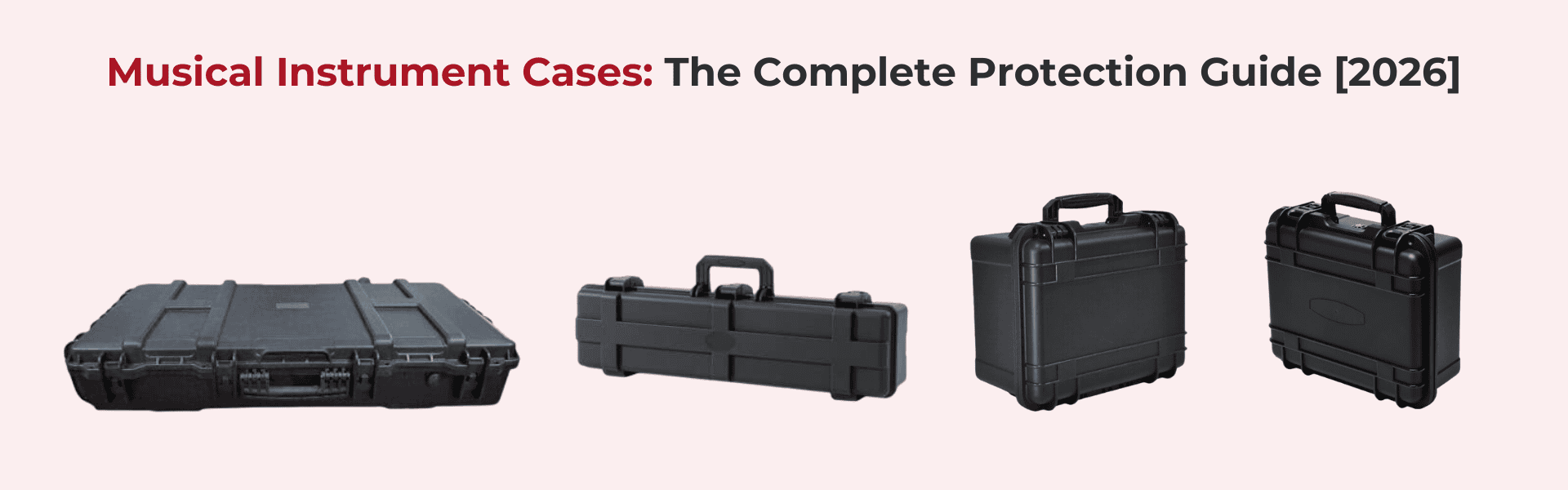
A musical instrument case is the one piece of gear that protects every other piece you own. Whether you play a flute that fits in a backpack or move a full DJ rig between venues, the case decides whether your instrument survives transport, weather, and the years of handling that come with playing. This guide covers how to choose a musical instrument case by instrument type, the protection tiers that actually matter, and how to size and foam a case so your instrument arrives the way it left.
This is the hub for our music and audio cluster. For deep dives, see the guitar hard cases guide and the DJ and audio flight cases guide.
Why Instruments Need a Hard Case
Soft gig bags are fine for the trip from home to a nearby lesson. The moment your instrument faces real transport, the calculation changes. Four threats account for almost all instrument damage.
Impact. A dropped case is the most common way instruments break. A rigid shell with foam absorbs the shock that a padded bag passes straight through.
Humidity. This matters more in India than almost anywhere. Wooden instruments crack and warp with humidity swings, and electronics corrode. A sealed case holds a stable internal environment.
Dust. Fine dust works into keys, valves, and connectors. A dustproof case keeps the mechanism clean.
Transport and air travel. Car boots, tour vans, trains, and airline holds all subject instruments to crushing loads and rough handling. A crushproof case is built for exactly this.
A hard case is an investment that protects a larger investment. The instrument outlives many cases, but only if the first case does its job.
Gig Bag vs Hard Case vs Flight Case
Each option sits at a different protection level. Match the case to how your instrument actually travels.
| Option | Protection | Best for | Weakness |
|---|---|---|---|
| Soft gig bag | Light knocks, weather cover | Local practice, short trips | No crush or water protection |
| Hard case | Impact, shape-fit | Studio, regular car travel | Often not sealed against water |
| Sealed flight case + foam | Crush, water, dust, pressure | Touring, flights, outdoor gigs | Larger, heavier |
For a player who gigs, tours, or flies, a sealed flight case with custom foam is the standard. It trades a slim profile for protection that survives rain at load-in, a humid coastal venue, and an airline hold.
The Three Protection Tiers Explained
Case N Foam cases carry a series letter that tells you exactly how much protection you get. Matching the tier to your instrument and your travel is the most important decision you make.
ET series (water resistant). Dustproof and crushproof, with resistance to spills and splashes, but not sealed for heavy rain or submersion. Good for indoor and covered use, like a pedalboard that stays on stage.
EW and EWL series (waterproof). Fully waterproof, dustproof, and crushproof, with a gasket seal and a pressure equalisation valve. The EWL series adds length and wheels for long instruments like guitars and basses. These are the touring and flight cases for serious players.
MAX series (IP67, military-grade). The top tier, with certified IP67 waterproofing, made in Italy. The MAX430 protective carry case suits instruments and gear that need documented protection for insurance or institutional use.
One rule keeps your claims honest: only the MAX series carries IP67. The EW and EWL series are waterproof but not IP67 rated, and the ET and E series are not waterproof at all.
Choosing a Case by Instrument Type
Different instruments have different enemies. Here is how to think about each family, with the Case N Foam models that fit.
Guitars and Basses
Guitars need length and width to clear the body, and basses need extra length for the long scale. The EWL9616-TR Guitar Hard Case (960 × 500 × 158 mm) covers acoustic and electric guitars, while the longer EWL10632-TR handles basses. For the full breakdown by acoustic, electric, bass, and pedalboard, see our dedicated guitar hard cases guide.
Flute and Woodwind
Flutes and other slim woodwinds need a long, narrow case rather than a deep one. The EW6713 Flute Carry Case (670 × 160 × 133 mm) is built exactly for this, with a long slim profile that fits a flute and its cleaning kit. It is a waterproof EW-series case, which protects a wooden or silver flute from the humidity that warps pads and tarnishes keys. For mixed small woodwinds, the EW3316 Instrument Carry Case offers a compact waterproof option.
Keyboards, Synths and MIDI
Compact keyboards and MIDI controllers are long and slim, and they prioritise length over depth. The E5012N Long Rectangular Equipment Case (500 × 290 × 116 mm) suits 25-key controllers and slim gear. Note that the E series is dustproof and crushproof but not waterproof, so it is an indoor and studio case. For a keyboard that travels to outdoor events, choose a sealed EW-series case instead.
Violin, Viola and Small Strings
Small string instruments are fragile and valuable, and they suit compact sealed cases. The EW3518 Instrument Case (350 × 302 × 180 mm) and EW3517 Instrument Safety Hard Case (355 × 305 × 162 mm) are waterproof options that hold a small instrument and its accessories in custom foam, with the sealed shell protecting against the humidity that cracks varnish and wood.
Brass and Larger Instruments
Trumpets, cornets, and similar brass instruments need depth for the bell and valves. The EW4117 Medium Instrument Case (404 × 308 × 170 mm) gives a waterproof home with room for custom foam shaped to the instrument. For larger or wheeled needs, the EW6529-TR Instrument Carry Case (648 × 395 × 285 mm) is a large waterproof trolley.
DJ and Audio Equipment
Controllers, mixers, and studio gear are as fragile as acoustic instruments, with exposed faders and connectors. The EW4625-U DJ Equipment Case and EW4418 Audio Mixer Case are waterproof flight cases for this gear. For the full guide including rack equipment, see the DJ and audio flight cases guide.
How to Size and Foam Your Instrument Case
The right size is the difference between protection and a rattle. Measuring takes a few minutes.
- Total length. The longest dimension of the instrument, including any protruding parts.
- Width and depth. The widest and deepest points, which set the case footprint and the foam depth.
- Add foam allowance. Plan 45 to 50 mm of cushioning on each side. Choose internal dimensions slightly larger than your raw measurements.
- Choose your foam type. Empty for your own packing, plain PU foam for basic cushioning, or custom CNC-cut XLPE foam shaped to the exact instrument.
When in doubt, size up. Foam fills extra space, but no foam fixes a case that is too small. Custom foam is worth the lead time for any instrument you transport regularly, because it holds the instrument so it cannot move and cannot be damaged by the case itself.
Protecting Instruments in Indian Conditions
Indian climate is hard on instruments, and the case is your main defence. Monsoon humidity warps wood and tarnishes metal, while summer heat in a parked car can soften adhesives and finishes.
A sealed EW or EWL case holds a stable internal environment, which is exactly what wooden and electronic instruments need. For long storage through the monsoon, add a silica desiccant pack inside the foam cavity to control moisture. Keep cases out of direct sunlight and out of hot car boots when possible. For instruments that move between an air-conditioned room and a humid outdoor stage in one evening, the sealed case prevents the rapid condensation that damages pads, electronics, and finishes.
Flying and Touring With Instruments
Air travel is where instruments are most at risk, and a few rules keep them safe.
Most instruments must be checked. Indian domestic cabin limits of roughly 55 × 35 × 25 cm and 7 kg rule out most full instrument cases. Plan to check sealed hard cases, or buy a cabin seat for a small, irreplaceable instrument on routes that allow it.
Lithium batteries fly in the cabin. Electronic instruments and wireless gear with lithium batteries follow DGCA and IATA rules: carry the batteries in the cabin, never in checked gear.
Detune string instruments slightly. Pressure and temperature changes add neck and bridge tension. Dropping the tuning a half step for a flight reduces stress.
Lock for checked travel. EW and EWL cases have reinforced padlock holes. Use TSA-approved locks for international routes.
What to Look For in a Quality Instrument Case
Two cases of the same size can protect very differently. These build details separate a case that lasts years from one that fails on the road.
Shell material. Case N Foam shells are moulded polypropylene, which flexes under impact and returns to shape instead of cracking. An instrument case takes knocks for the life of the instrument, and a shell that absorbs shocks is doing the real work.
Seal and valve. On the EW and EWL series, the gasket runs the full perimeter for a continuous seal, and a pressure equalisation valve balances internal and external pressure so a case sealed at one altitude opens easily after a flight. These two features are what make a case genuinely waterproof rather than merely water resistant.
Latches. Look for latches that stay positively closed under spring tension, not friction clips that pop open when a case is dropped or stacked. A failed latch at the wrong moment undoes everything else.
Foam. Pre-cut pluck foam is convenient but tears and loosens over time. Custom CNC-cut XLPE foam holds the instrument exactly in place, supports fragile points like a flute headjoint or a guitar neck, and lasts for years. For any instrument you move regularly, custom foam is the detail that pays for itself.
Lock points. Reinforced, integrated padlock holes let you secure the case for checked travel and venue storage. Avoid riveted-on tabs that can be pried away.
When you compare cases, weigh these against the price. A sealed shell, a real gasket, and custom foam cost more than a friction-clip box, and they are the reason the instrument inside stays safe.
Top Musical Instrument Cases for 2026
| Instrument | Model | Internal Dimensions | Series |
|---|---|---|---|
| Guitar, bass | EWL9616-TR | 960 × 500 × 158 mm | EWL (waterproof) |
| Flute, woodwind | EW6713 | 670 × 160 × 133 mm | EW (waterproof) |
| Keyboard, MIDI (indoor) | E5012N | 500 × 290 × 116 mm | E (not waterproof) |
| Violin, small strings | EW3518 | 350 × 302 × 180 mm | EW (waterproof) |
| Brass, medium instruments | EW4117 | 404 × 308 × 170 mm | EW (waterproof) |
| DJ controller, mixer | EW4625-U | 460 × 345 × 250 mm | EW (waterproof) |
Every model is available empty, with plain PU foam, or with custom CNC-cut XLPE foam shaped to your instrument. Custom foam adds roughly 7 to 15 working days to dispatch.
Frequently Asked Questions
What is the best type of musical instrument case?
For any instrument that travels, gigs, or flies, a sealed waterproof hard case with custom foam offers the most protection. It guards against impact, water, dust, and pressure, where a soft gig bag only handles light knocks. Match the case size to your instrument and add custom foam for a precise fit.
Are these cases waterproof?
It depends on the series. EW and EWL cases are fully waterproof, the MAX series is IP67 rated, the ET series is water resistant only, and the E series is dustproof and crushproof but not waterproof. Check the series letter before buying for outdoor or monsoon use.
Which case is best for a flute?
The EW6713 Flute Carry Case (670 × 160 × 133 mm) is the dedicated option, with a long slim waterproof profile that fits a flute and cleaning kit. The sealed shell protects against the humidity that damages pads and tarnishes keys.
Can I get a case shaped to fit my exact instrument?
Yes. Order any case with custom CNC-cut XLPE foam, which is shaped to your instrument’s outline so it is held in place and protected at every point. Share your instrument model or measurements when ordering custom foam.
Will my instrument case fit in an airline cabin?
Most full instrument cases exceed Indian domestic cabin limits of around 55 × 35 × 25 cm and 7 kg. Plan to check sealed hard cases, and carry lithium batteries from electronic instruments separately in the cabin.
How do I protect a wooden instrument from humidity?
Use a sealed EW or EWL case and add a silica desiccant pack inside the foam cavity. Keep the case out of direct sunlight and hot car boots, and avoid rapid temperature changes that cause condensation.
Do the cases include foam?
Foam is an optional variant. You can order a case empty, with plain PU foam for basic cushioning, or with custom XLPE foam cut to your exact instrument. Custom foam is the option worth the lead time for a valuable or frequently moved instrument.
Which case do I need for a DJ controller or mixer?
The EW4625-U DJ Equipment Case suits standalone controllers, and the EW4418 Audio Mixer Case fits compact mixers and field recorders. Both are waterproof. For the full breakdown including rack gear, see the DJ and audio flight cases guide.
Choosing the Case That Protects It All
A musical instrument case is the foundation of caring for any instrument, from a flute to a full DJ rig. Match the protection tier to where you play, choose internal dimensions slightly larger than your instrument, and add custom foam for a precise fit. Guitarists and bassists should read the guitar hard cases guide, and anyone moving controllers, mixers, or studio gear should see the DJ and audio flight cases guide.
Shop musical instrument cases at Case N Foam and order online. Custom foam consultation available on request. Ships free across India.