



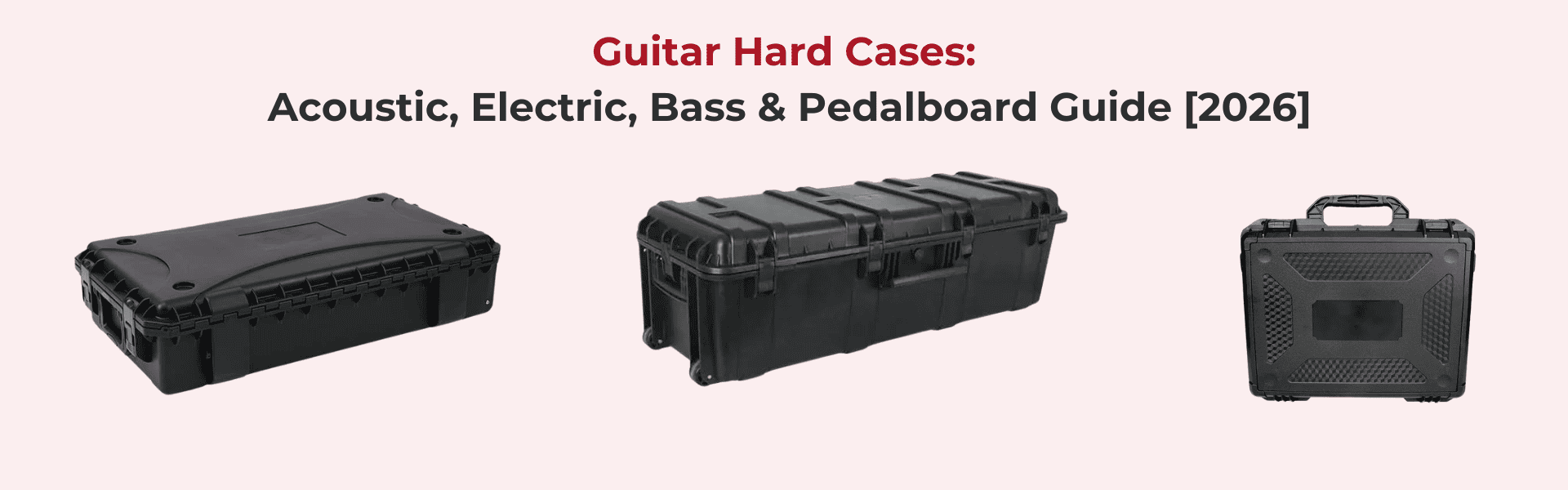
A guitar hard case earns its keep the first time your instrument rides in a car boot over Indian roads, gets loaded into a tour van, or goes into an airline hold. A padded gig bag handles a walk to practice. It does not handle a 200 km drive, a monsoon downpour at a load-in, or baggage handlers who have never held a guitar. This guide covers how to choose a guitar hard case by instrument type, the real internal dimensions that decide whether your guitar actually fits, and why a sealed waterproof case with custom foam protects better than a traditional contoured case.
For the wider view across all instrument types, start with our musical instrument cases guide. If you move audio gear too, see the DJ and audio flight cases guide.
Gig Bag vs Hard Case vs Flight Case
These three options protect at very different levels. Matching the case to how you actually move your guitar saves both money and heartbreak.
| Option | Protection | Best for | Weakness |
|---|---|---|---|
| Padded gig bag | Light knocks, weather cover | Walking to lessons, local practice | No crush protection, not sealed |
| Contoured hard case | Impact, shape-fit | Studio, occasional car travel | Usually not waterproof, foam wears |
| Sealed hard case + foam | Crush, water, dust, pressure | Touring, flights, field gigs | Larger footprint, heavier |
A contoured guitar case (the moulded shape most players know) protects against impact but rarely seals against water or dust. The plush lining compresses over years and the latches loosen. A sealed polypropylene hard case with custom foam takes a different approach: a rigid waterproof shell with a gasket seal, and a foam insert cut to cradle your specific guitar. You give up the slim guitar silhouette and gain a case that survives rain, dust, and a drop from a loading ramp.
Choosing a Guitar Hard Case by Instrument Type
The single most important number is internal length, followed by internal width at the lower bout. Get those right and the rest is foam. Below are the Case N Foam models suited to each guitar type, with the dimensions that matter.
Acoustic and Classical Guitars
Acoustic guitars are the hardest to fit because of their wide lower bout, typically 380 to 400 mm on a dreadnought. Your case needs internal width of at least 400 mm, not just enough length.
The EWL9616-TR Guitar Hard Case has internal dimensions of 960 × 500 × 158 mm. The 500 mm width comfortably clears any acoustic body, and the 960 mm length fits parlour, concert, classical, and most electro-acoustic guitars. For a full-size dreadnought, measure your guitar’s total length before ordering, since a long dreadnought can run close to or past 1000 mm. The case is part of the EWL series, so it is waterproof, dustproof, and crushproof, with a pressure equalisation valve and integrated wheels for moving it through airports and venues.
Electric Guitars
Electric guitars are easier to case because the solid body is narrower, usually 320 to 340 mm at the widest point, and the overall length sits around 980 to 1000 mm for a Stratocaster or Les Paul style instrument.
Both the EWL9616-TR (960 × 500 × 158 mm) and the longer EWL10632-TR Guitar Flight Case (1061 × 348 × 318 mm) work for electrics. The EWL9616-TR is the wider, shallower option for a single electric with room for cables and a tuner. The EWL10632-TR is longer and much deeper at 318 mm, which suits an electric with a tremolo arm, locking nut hardware, or an angled headstock that needs clearance. Both are waterproof EWL-series cases.
Bass Guitars and Long-Scale Instruments
Bass guitars run long. A standard 34 inch scale bass measures around 1140 to 1170 mm in total length, and extended-range or headless designs vary further.
The EWL10632-TR Guitar Flight Case is the long-scale option at 1061 mm internal length, 348 mm width, and a deep 318 mm. Measure your bass end to end before ordering, because a long 5-string may need the foam cavity arranged diagonally to fit. The depth is the advantage here: a bass with a bolt-on neck and a chunky bridge sits with clearance, and the custom foam locks it in place so the headstock cannot knock against the shell in transit.
Pedalboards and Effects
Your pedals are as fragile as your guitar, and a loose patch cable or a cracked jack ends a gig just as fast as a broken string.
For a compact board, the ET3914 Pedalboard Case (390 × 310 × 144 mm) holds a small to medium pedalboard. Note that the ET series is water resistant, not fully waterproof, so it suits indoor and covered-stage use rather than open-air monsoon gigs. For a larger rig with a multi-effects unit, expression pedals, and a power supply, the EWL8018-TR Guitar Pedalboard Case (802 × 412 × 182 mm) is the waterproof EWL-series option with wheels, built for touring boards that travel weekly.
How to Size Your Guitar Hard Case
Measuring takes two minutes and prevents the most common return reason: a case that is 30 mm too short.
- Total length. Lay the guitar flat and measure from the top of the headstock to the bottom of the body. This is the number that must fit inside the case length.
- Lower bout width. Measure the widest point of the body. This must fit inside the case width.
- Maximum depth. Measure the deepest point, usually the body with the bridge and any hardware. This sets the foam depth you need.
- Add foam allowance. Custom foam needs roughly 45 to 50 mm of cushioning around the instrument. Pick a case with internal dimensions slightly larger than your raw measurements.
When a guitar sits between two case sizes, size up. A guitar that rattles in too large a case is fixed with foam. A guitar that does not fit a too-small case is simply returned.
Waterproof vs Water Resistant for Guitars
The series letter tells you the protection level, and it matters more for guitars than most gear because wood and electronics both hate moisture.
- EWL series (waterproof). The EWL9616-TR, EWL10632-TR, and EWL8018-TR are fully waterproof, dustproof, and crushproof, with a gasket seal and a pressure equalisation valve. These are the touring and flight cases. Rain at load-in, a humid coastal venue, or a flooded loading dock will not reach your instrument.
- ET series (water resistant). The ET3914 pedalboard case is water resistant and dustproof, which covers spills, splashes, and damp floors, but it is not sealed for submersion or heavy rain. Use it indoors or under cover.
For Indian conditions, where a single gig can move from an air-conditioned green room to a humid open-air stage in one evening, the sealed EWL cases hold a stable internal environment. Add a silica desiccant pack inside the foam cavity for long storage in monsoon months.
Flying and Touring With a Guitar
Guitars and aircraft have a complicated relationship. The rules below reflect how Indian carriers and international airlines actually handle instruments in 2026.
Check before you fly. Most Indian domestic cabins cap carry-on at 7 kg and around 55 × 35 × 25 cm, which no full guitar case meets. Plan to check your guitar in a sealed hard case, or buy a seat for it on long international routes if the instrument is irreplaceable.
Detune slightly for flights. Cabin and hold pressure changes put extra tension on the neck. Dropping the tuning a half step for a flight reduces stress on the truss rod and bridge.
Custom foam is the difference. A guitar that cannot move inside the case cannot be damaged by the case. Custom CNC-cut foam holds the instrument at the body and the neck so the fragile headstock never takes a direct hit. See our custom foam guide for how to decide between pre-cut and custom.
Lock it. Every EWL case has reinforced padlock holes. Use TSA-approved locks for international travel so security can inspect and relock without cutting.
What to Look For in a Guitar Hard Case
Two cases can share the same internal dimensions and protect very differently. These are the build details that separate a touring-grade guitar case from a box that looks the part.
Shell material. Case N Foam shells are moulded polypropylene, which flexes under impact and returns to shape rather than cracking like cheaper rigid plastics. A guitar case lives a hard life on van floors and luggage belts, and a shell that absorbs shocks protects the instrument inside.
Latches and seal. Look for latches that stay positively closed under their own spring tension, not friction clips that pop open when the case is dropped. On the EWL series, the gasket runs the full perimeter so the seal is continuous, which is what keeps water and dust out.
Wheels and handle. A loaded guitar flight case is heavy, and the wheels and telescoping handle take the strain. Bolt-mounted wheels can be replaced when they wear; riveted wheels cannot. The EWL9616-TR, EWL10632-TR, and EWL8018-TR all run on integrated wheels with a pull handle for moving through venues and terminals.
Foam strategy. Pre-cut pluck foam works for a quick fit, but it tears and loosens over time. Custom CNC-cut XLPE foam holds its shape for years and supports the guitar at the body and neck so the headstock never takes a hit. For an instrument you gig with weekly, custom foam is the part that pays for itself.
Padlock points. Reinforced, integrated padlock holes let you secure the case for checked travel or venue storage. Avoid cases where the lock points are riveted-on tabs that can be pried away.
Top Guitar Case Picks for 2026
| Use Case | Model | Internal Dimensions | Series | Wheels |
|---|---|---|---|---|
| Acoustic, classical, electric | EWL9616-TR | 960 × 500 × 158 mm | EWL (waterproof) | Yes |
| Bass, long-scale, deep-body electric | EWL10632-TR | 1061 × 348 × 318 mm | EWL (waterproof) | Yes |
| Touring pedalboard | EWL8018-TR | 802 × 412 × 182 mm | EWL (waterproof) | Yes |
| Compact pedalboard, indoor | ET3914 | 390 × 310 × 144 mm | ET (water resistant) | No |
Every model is available empty, with plain PU foam, or with custom CNC-cut XLPE foam shaped to your exact instrument. Custom foam adds roughly 7 to 15 working days to dispatch.
Frequently Asked Questions
What size hard case do I need for an acoustic guitar?
Measure your guitar’s total length and lower bout width first. A dreadnought needs at least 400 mm internal width and close to 1000 mm length. The EWL9616-TR (960 × 500 × 158 mm) fits most acoustics, but verify a long dreadnought’s total length against the 960 mm internal length before ordering.
Will a guitar hard case fit in an airline cabin?
No full-size guitar case meets Indian domestic cabin limits (around 55 × 35 × 25 cm, 7 kg). Plan to check your guitar in a sealed waterproof case, or purchase a cabin seat for the instrument on international routes that allow it.
Are these cases shaped like a guitar inside?
No. They are rectangular waterproof hard cases. The guitar shape is created by custom CNC-cut foam that cradles your specific instrument. This is what makes them waterproof and crushproof, unlike traditional contoured cases that are moulded to a guitar silhouette but rarely sealed.
Is the EWL9616-TR fully waterproof?
Yes. The EWL series is waterproof, dustproof, and crushproof with a gasket seal and pressure equalisation valve. The ET3914 pedalboard case, by contrast, is water resistant only and best used indoors or under cover.
Which case is best for a bass guitar?
The EWL10632-TR Guitar Flight Case at 1061 mm internal length is the long-scale option. Measure your bass end to end, since a long 5-string may need the custom foam cavity arranged diagonally to fit comfortably with clearance for the headstock.
Can I store my guitar long-term in one of these cases?
Yes, and a sealed EWL case is excellent for monsoon-season storage. Add a silica desiccant pack inside the foam cavity to control humidity, and detune the strings slightly to reduce long-term neck tension.
Do the cases come with foam included?
Foam is an optional variant. You can order a case empty, with plain PU foam for basic cushioning, or with custom XLPE foam cut to your exact guitar or pedalboard. For a fragile instrument, custom foam is the option worth the extra few days of lead time.
How is the foam cut to fit my guitar?
Custom XLPE foam is CNC-cut to your instrument’s outline so the body and neck are held in place and the headstock never contacts the shell. Share your guitar model or measurements when ordering custom foam, and the cavity is shaped accordingly.
Protecting the Guitar You Play
The right guitar hard case depends on what you play and how far it travels. Acoustic and electric players are covered by the wide EWL9616-TR. Bass and long-scale players need the longer, deeper EWL10632-TR. Touring pedalboards travel in the EWL8018-TR, while a compact indoor board fits the water-resistant ET3914. In every case, custom foam is what turns a rectangular box into protection shaped around your instrument.
For the full range across every instrument family, return to the musical instrument cases guide. If you also haul mixers, controllers, or studio gear, the DJ and audio flight cases guide covers those.
Shop guitar cases at Case N Foam and order online. Custom foam consultation available on request. Ships free across India.